
France
Germaine Sevestre was born in Paris in 1897 to a family of the middle-bourgeoisie. She seems to have begun learning piano at a very young age, with her mother. She underwent strict religious education and had access to good schooling, obtaining a teacher’s licence.
In November 1918, at age 21, she successfully passed the entrance examinations for the Paris Conservatory, which at the time was directed by Gabriel Fauré. She entered Auguste Chapuis’ harmony class, and studied history of music under Maurice Emmanuel. Germaine Tailleferre, Jacques Ibert, Simone Plé, Yvonne Lefébure, Robert Casadesus, and others numbered among her schoolmates. She built solid friendships which she would maintain all her life. However, she paused her musical studies to marry in November 1919, after which she hyphenated her name as Germaine Coulpied-Sevestre.
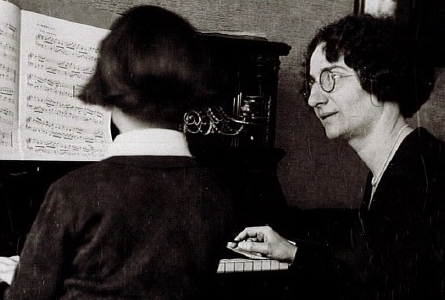
In the early 1920s, she became a music teacher in a Parisian secondary school, and taught piano at her home. As a teacher, she felt the need to create her own tools to ensure her pupils’ progress. Starting in 1933, she collaborated on her first series of pedagogical works, published by Éditions Henry Lemoine. In parallel, she composed small pieces for younger musicians, taught voice, and provided piano accompaniment for religious ceremonies.
Her first collection of works for piano duet, La Ferme de l'Oncle Pierre, was published in 1939 by Éditions Max Eschig under the name G. Coulpied-Sevestre. She passed the entrance examination for the SACEM in 1940, and released two collections of children’s music titled Je donne un récital : trois pièces enfantines à grand effet, published in 1943 by H. Herelle.
In the 1950s, she began collaborating with publisher Les Éditions Philippo (which soon merged with Éditions Combre), publishing numerous collections for solo piano and piano duet aimed at children. Recognised by her peers as a talented composer and teacher, she began a collaboration with the École Normale de Musique de Paris, preparing young piano students for graduate-level classes. She also developed a bespoke piano teaching method for the school. In 1966, Christian Manen submitted one of her pieces to the prestigious Léopold Bellan International Competition.
Over the years, she continued to publish collections aimed at children with Éditions Combre and Éditions Henry Lemoine. She ended her musical career in 1982 due to declining health and left Paris, where she had lived her whole life. She died in 1985 at age 87.
Besides having dedicated her career to teaching piano, she spent over forty years almost exclusively composing works for children. Her body of work, published between 1939 and 1980, is mostly available through Éditions Henry Lemoine: 6 pedagogical works, and over 200 pieces for children collected in 19 compendiums, signed G. Coulpied-Sevestre.
– Cécile Coulpied –
[Traduction en anglais : Raphaël Meyer]
In November 1918, at age 21, she successfully passed the entrance examinations for the Paris Conservatory, which at the time was directed by Gabriel Fauré. She entered Auguste Chapuis’ harmony class, and studied history of music under Maurice Emmanuel. Germaine Tailleferre, Jacques Ibert, Simone Plé, Yvonne Lefébure, Robert Casadesus, and others numbered among her schoolmates. She built solid friendships which she would maintain all her life. However, she paused her musical studies to marry in November 1919, after which she hyphenated her name as Germaine Coulpied-Sevestre.
In the early 1920s, she became a music teacher in a Parisian secondary school, and taught piano at her home. As a teacher, she felt the need to create her own tools to ensure her pupils’ progress. Starting in 1933, she collaborated on her first series of pedagogical works, published by Éditions Henry Lemoine. In parallel, she composed small pieces for younger musicians, taught voice, and provided piano accompaniment for religious ceremonies.
Her first collection of works for piano duet, La Ferme de l'Oncle Pierre, was published in 1939 by Éditions Max Eschig under the name G. Coulpied-Sevestre. She passed the entrance examination for the SACEM in 1940, and released two collections of children’s music titled Je donne un récital : trois pièces enfantines à grand effet, published in 1943 by H. Herelle.
In the 1950s, she began collaborating with publisher Les Éditions Philippo (which soon merged with Éditions Combre), publishing numerous collections for solo piano and piano duet aimed at children. Recognised by her peers as a talented composer and teacher, she began a collaboration with the École Normale de Musique de Paris, preparing young piano students for graduate-level classes. She also developed a bespoke piano teaching method for the school. In 1966, Christian Manen submitted one of her pieces to the prestigious Léopold Bellan International Competition.
Over the years, she continued to publish collections aimed at children with Éditions Combre and Éditions Henry Lemoine. She ended her musical career in 1982 due to declining health and left Paris, where she had lived her whole life. She died in 1985 at age 87.
Besides having dedicated her career to teaching piano, she spent over forty years almost exclusively composing works for children. Her body of work, published between 1939 and 1980, is mostly available through Éditions Henry Lemoine: 6 pedagogical works, and over 200 pieces for children collected in 19 compendiums, signed G. Coulpied-Sevestre.
– Cécile Coulpied –
[Traduction en anglais : Raphaël Meyer]
List of Works
Useful links
Contributor:
Présence Compositrices - last updated 10 December 2025